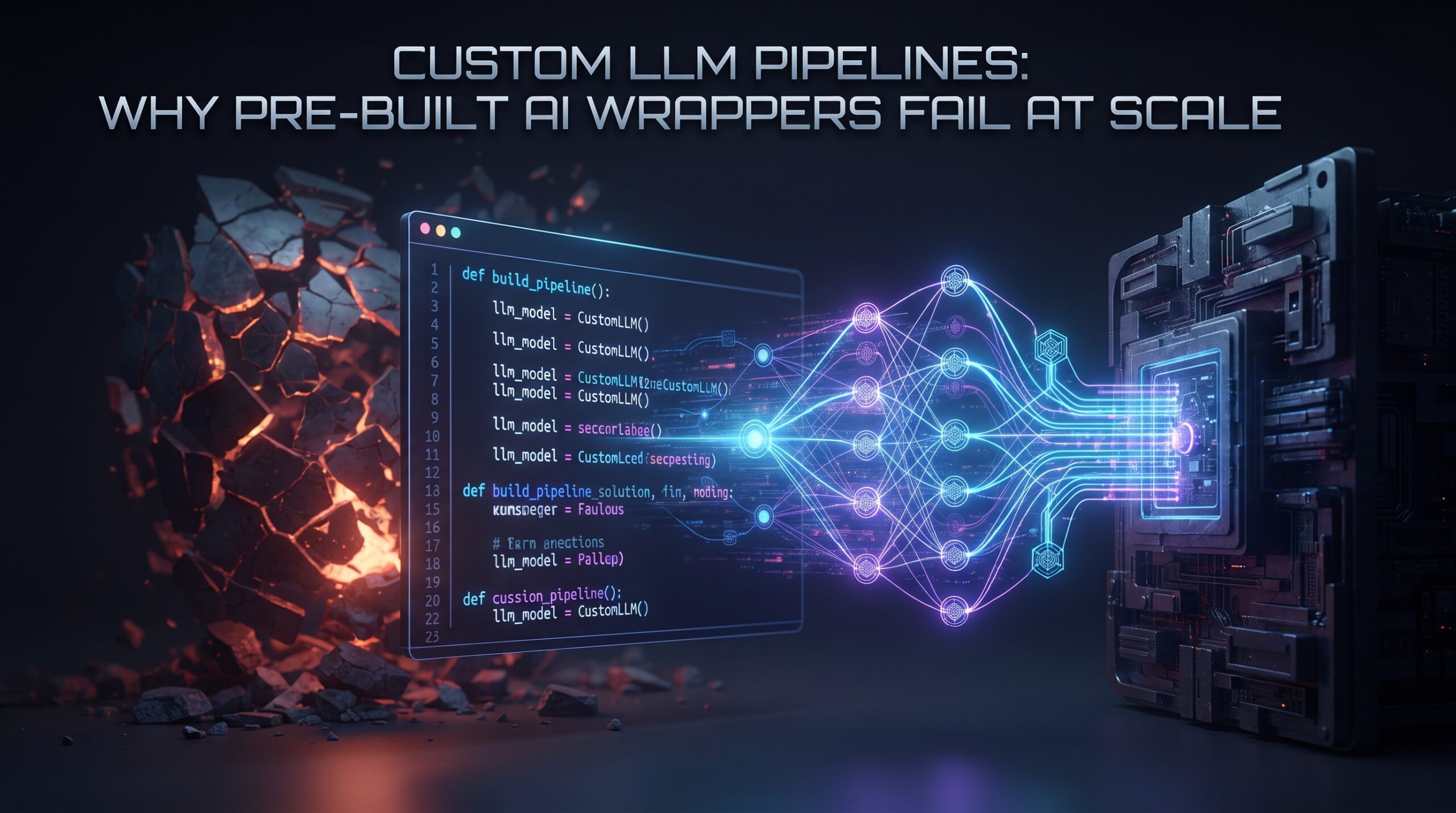
When businesses rush to adopt artificial intelligence, custom LLM pipelines often take a backseat to quick, pre-built solutions. The tech landscape is flooded with ready-to-use AI wrappers—lightweight apps that simply slap a user-friendly interface onto commercial APIs like OpenAI or Anthropic. However, for a basic chatbot or a simple proof-of-concept, these wrappers seem like a dream come true.
However, as startups grow and enterprises demand heavy data processing, security compliance, and reliable uptime, these generic tools quickly hit a brick wall. Scaling an AI-driven product requires far more than basic API calls; it demands a robust, purpose-built architecture.
If your digital product is struggling with performance bottlenecks, unpredictable costs, or data privacy concerns, it’s time to look under the hood. Let’s break down why pre-built wrappers crumble under pressure and why engineering custom LLM pipelines from scratch is the ultimate solution for long-term scalability.
Understanding AI Wrappers vs. Custom LLM Pipelines
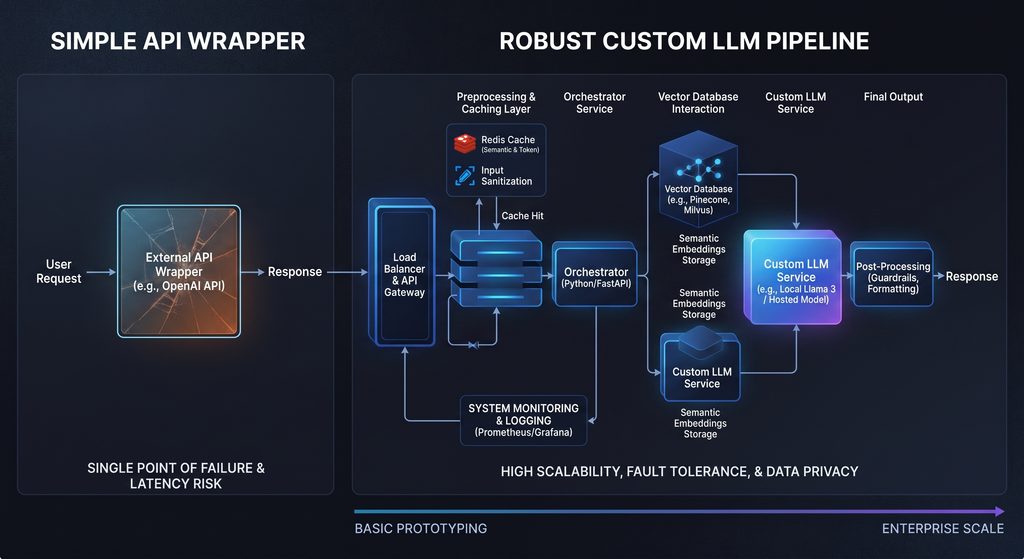
To understand why scaling breaks down, we need to look at how both approaches are structured from a development perspective.
- Pre-Built AI Wrappers: These are surface-level applications that rely entirely on third-party vendor APIs with minimal backend logic. They offer rapid deployment and low upfront development costs, but leave you completely at the mercy of external rate limits, sudden API changes, and black-box processing.
- Custom LLM Pipelines: Built from the ground up using robust backend frameworks (like Python, FastAPI, or Node.js), these pipelines incorporate vector databases, caching layers, custom tokenizers, and multi-step retrieval-augmented generation (RAG) workflows tailored specifically to your business logic.
Why Pre-Built AI Wrappers Fail at Enterprise Scale
Relying on a generic wrapper might get your app live in a week, but it introduces critical vulnerabilities as user concurrency increases.
- Unpredictable Latency and Rate Limits: Furthermore, when thousands of users hit a generic wrapper simultaneously, external API queues choke. Because you don’t control the underlying infrastructure, your app suffers from random lag and downtime.
- Data Privacy and Compliance Gaps:Moreover, enterprise clients will never trust a generic wrapper with proprietary data or Personally Identifiable Information (PII). Custom pipelines allow you to implement strict, localized security protocols and data masking.
- Escalating Token Costs: Inefficient prompt management and lack of caching in wrapper apps mean you end up sending redundant data to the LLM on every single request, multiplying your cloud overhead bills exponentially.
Custom LLM Pipelines vs. Pre-Built Wrappers: Direct Comparison
| Feature | Pre-Built AI Wrappers | Custom LLM Pipelines |
| Architecture | Simple API frontend wrapper | Multi-layered backend engineering |
| Scalability | Limited by third-party rate caps | Highly scalable with load balancing |
| Data Security | Vulnerable to external data policies | Enterprise-grade, localized control |
| Cost Efficiency | High long-term token waste | Optimized via caching and smart routing |
| Best Used For | Prototyping, MVP testing, basic tasks | Enterprise software, SaaS platforms, high-data apps |
How Custom LLM Pipelines Solve Scaling Bottlenecks
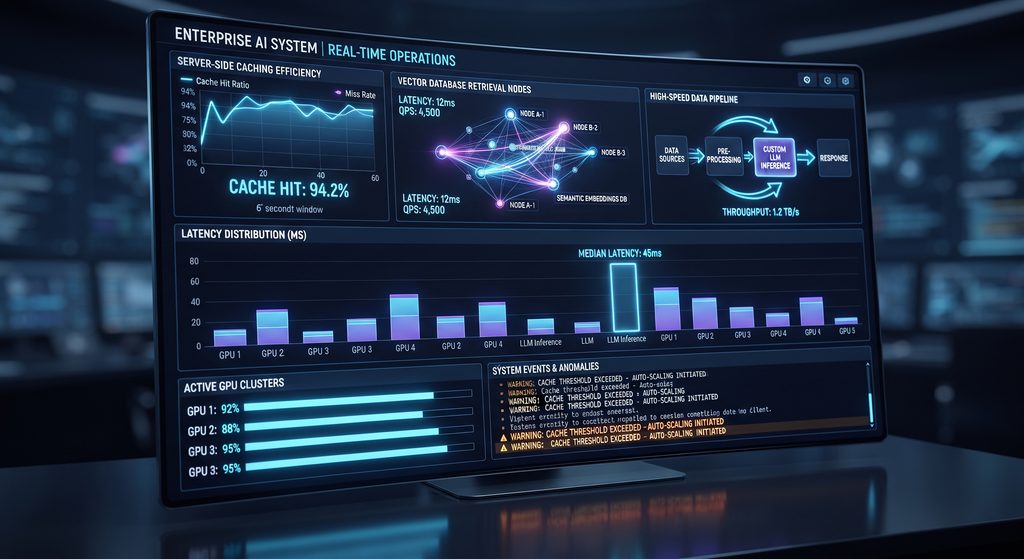
Transitioning to a custom architecture gives development teams the granular control needed to handle heavy enterprise workloads without breaking a sweat.
- Intelligent Caching and Vector Retrieval: Therefore, instead of querying the LLM for every repetitive user prompt, custom pipelines use vector databases (like Pinecone or Milvus) and semantic caching to instantly serve pre-computed answers, drastically reducing response times.
- Modular Model Swapping: With a custom pipeline, you aren’t locked into a single AI provider.Additionally, if a new, faster open-source model emerges, your backend can swap or blend models seamlessly without rewriting your entire application frontend.
Conclusion
While AI wrappers serve a purpose during the initial brainstorming phase, they are structural dead-ends for serious digital products. Building custom LLM pipelines ensures your software remains secure, cost-efficient, and lightning-fast as your user base expands.
Ready to scale your software with enterprise-grade architecture? Explore advanced development solutions at De Buggers to build secure, high-performance AI applications from the ground up.